

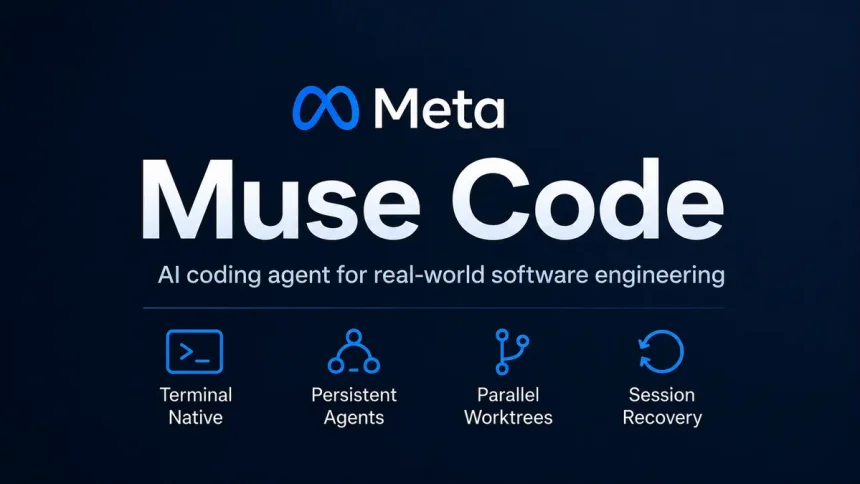
On August 5, 2026, Meta officially unveiled Muse Code — its own code-writing agent, running on the updated Muse Spark 1.2 model. The release, which arrived as a public beta, became Meta’s most visible move in the battle for the market of AI assistants for developers, a space already anchored by Anthropic with its Claude Code and OpenAI with Codex. In effect, Meta openly declared its intention to win a share of a segment that over the past year has turned into one of the hottest fronts of competition among AI labs.
To grasp the significance of the event, it is worth recalling the backstory. As early as April 2026, Meta made a move that surprised the industry: the company effectively abandoned the Llama brand — its line of open models that for years had been a symbol of Meta’s “open” approach to AI — and introduced the proprietary Muse Spark model. This was the first major release after the formation of the Meta Superintelligence Labs division, and it was described as a “ground-up overhaul.” Such a turn meant a shift away from open source toward a closed model, closer in philosophy to the products of OpenAI and Anthropic. In July came the Muse Spark 1.1 version, and that same week Meta publicly signaled its entry into the AI coding market for the first time. The August launch of Muse Code alongside Muse Spark 1.2 completed this logical sequence.
Technically, Muse Code is a terminal-based agent — a tool that works from the command line rather than as a separate application with a graphical interface. Here Meta deliberately took a different path than OpenAI with its standalone Codex app: developers are offered installation via a single line of a bash script on macOS and Linux. Functionally, the agent can not only generate code but also plan changes to a project, validate the results of its own work, and orchestrate several sub-agents at once. One of the key features is persistent asynchronous background agents: tasks can run in the background over an extended period, while local event logging allows work to resume after a crash or restart without losing context. This is a response to one of the main pain points of modern AI assistants — instability during long, multi-step tasks.
The pricing strategy proved no less aggressive. The standard Muse Code tariff is roughly $1.25 per million input tokens and $4.25 per million output tokens. But Meta also offered a separate “contributor tier”: about $0.10 per million input and $0.20 per million output tokens in exchange for the user’s consent to provide feedback for improving the model. This is dramatically — more than tenfold — cheaper than the standard rates and directly undercuts the pricing position of competitors. Meta’s Chief AI Officer Alexandr Wang, who was quoted in connection with the release, emphasized precisely this model of collaboration with developers: cheaper access in exchange for data that helps train future versions.
Strategically, the launch of Muse Code fits into the broader picture of the 2026 AI-lab race. Anthropic, with its Claude line, is considered the leader specifically in the coding domain, and Meta openly positions Muse Spark 1.2 as a tool that competes on price with Anthropic’s flagship models. For Meta, this is not just another product but a way to prove that the enormous investments in Superintelligence Labs and the shift from open source to proprietary models pay off in real, market-competitive tools. A company that for years was associated with the open weights of Llama is now playing by the rules of closed labs — and it has chosen coding as the field on which to test those rules in practice.
For developers, the arrival of yet another strong player means, above all, pressure on prices and faster tooling improvements. If Meta’s contributor tier proves stable and high-quality, it could force competitors to reconsider their own rates. At the same time, critics are already pointing to the obvious trade-off: cheaper access in exchange for user data is a model in which developers’ code and working patterns become fuel for training the next versions of the model. How comfortable that exchange will be for corporate clients with sensitive codebases is a question the market will answer in the coming months.
To assess why Meta invested so many resources specifically in coding, it is worth understanding what this segment became for the entire industry in 2025–2026. Programming assistants have turned into one of the few areas where the benefit of AI is direct, measurable, and monetizable: developers pay for tools that genuinely speed up their work, and companies are willing to sign enterprise contracts for entire teams. That is why “agentic coding” — where a model does not merely suggest a line but independently plans and makes changes to large codebases — is considered one of the first truly large-scale applications of generative AI. Anthropic with its Claude Code, OpenAI with Codex, and now Meta with Muse Code are effectively competing over who will become the standard tool in the workflow of millions of programmers — and through them, over the loyalty of entire engineering organizations.
For Meta, this is simultaneously an enormous bet and a serious reputational risk. The company spent years building an image as the chief champion of open AI: the Llama models were downloaded millions of times, startups and research projects were built on them, and “openness” itself was part of Meta’s identity in the eyes of the community. The shift to the closed Muse Spark model and the paid Muse Code agent means a break with that tradition and a move onto territory where the rules are dictated by product quality and price, not by a philosophy of openness. The success of Muse Code must prove that the costly investments in Superintelligence Labs and the loud poaching of researchers from other labs were justified. A failure, on the contrary, would cast doubt on Meta’s entire pivot strategy. That is why the August release is not merely a technical news item but a test of whether Mark Zuckerberg’s company can compete on equal footing with pure AI labs on their own turf.
What is worth watching in the coming months? First, the reaction of competitors: if Meta’s contributor tier proves stable and high-quality, Anthropic and OpenAI may be forced to reconsider their own pricing, triggering a full-blown price war in the AI coding market. Second, enterprise adoption: large companies with sensitive codebases will carefully assess how safe it is to trust their code to an agent that learns from user data — and this is precisely where the main vulnerability of Meta’s cheap model lies. Third, the pace of updates: in the race of AI assistants, the winner is not the one who launched first but the one who improves the model faster, so the next versions of Muse Spark will be a real test of the seriousness of Meta’s intentions. Together, these factors will determine whether Muse Code becomes a full-fledged competitor to the market leaders or remains an ambitious but secondary attempt.
Sources: CNBC, Engadget, 9to5Mac, VentureBeat, TechCrunch, Meta AI Research blog (August 5, 2026).