

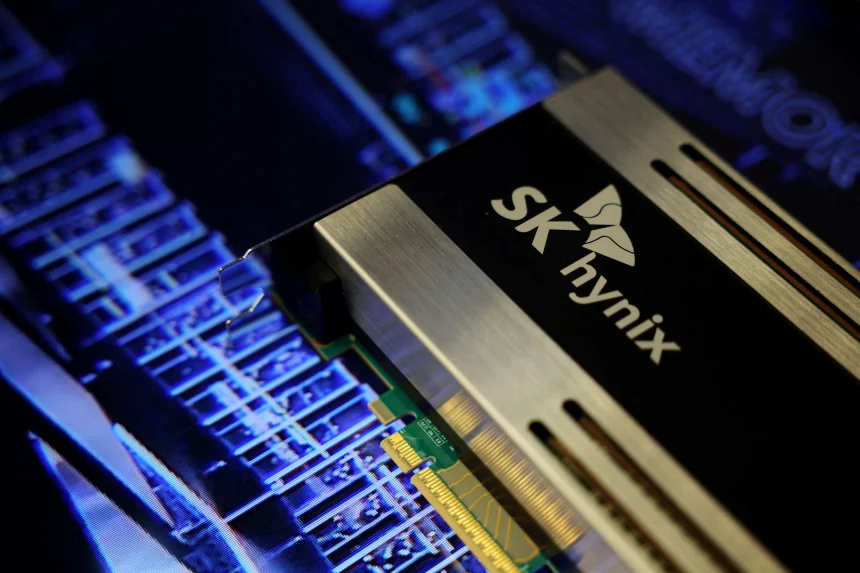
The artificial-intelligence boom has brought the South Korean memory-chip makers — Samsung Electronics and SK Hynix — record profits, above all thanks to the frenzied demand for high-bandwidth memory (HBM), which is a critical component for AI accelerators. But along with the profits came pressure: shareholders of both companies are demanding significantly larger payouts from the generous cash flows that are accumulating. This was reported on August 5, 2026, by the Reuters agency in an analytical piece that outlined the growing discontent of investors with the conservative capital-allocation policy of the Korean giants.
The scale of the accumulated cash is striking and explains the reason for the discontent. According to forecasts, by year-end the combined net cash reserves of Samsung and SK Hynix will reach roughly $263 billion — more than double the corresponding figure for Nvidia (about $102 billion). For investors, such a “cash mountain” became a source of frustration: the companies are earning enormous sums on the AI boom but, in the shareholders’ view, are not sharing enough of it through dividends and share buybacks. The investors’ logic is simple: if capital is not working efficiently and is merely accumulating on the balance sheet, it should be returned to the owners.
The discontent has specific faces and demands. Vista Global Asset Management portfolio manager Kim Kyu-shik frankly described his reaction to SK Hynix’s results: “I was really infuriated after the [earnings] call,” emphasizing the need for clearer commitments on returning capital to shareholders. London-based Janus Henderson Investors portfolio manager Richard Clode made a specific demand: he wants SK Hynix to raise payouts to at least 80% of free cash flow — versus the current target of 50%. Clode called the company’s balance sheet “incredibly inefficient,” referring precisely to the excessive accumulation of cash.
Samsung feels the pressure too. The Korean retail-investor platform ACT, represented by Lee Sang-mok, is campaigning for the holding of an extraordinary shareholders’ meeting and for a share buyback totaling $32 billion. This shows that the discontent extends beyond large institutional investors and also encompasses a broad circle of retail shareholders, who in Korea are traditionally an active and politically visible force.
The activists’ key argument is a comparison with competitors. Both Korean companies currently target roughly 50% of free cash flow as the goal for shareholder payouts. The American competitor Micron, by contrast, in June 2026 pledged to return 100% of free cash flow. Against the backdrop of such a commitment, the policy of Samsung and SK Hynix looks, in the eyes of investors, too cautious, especially given the record profits from HBM memory. It is precisely this contrast that fuels the demands to raise payouts: if a competitor is ready to hand over all of its free cash flow, why do the Korean giants retain twice as little?
The companies, for their part, call for patience. Both Samsung and SK Hynix have said they will announce updated plans for returning capital to shareholders by the end of 2026, citing the need to balance capital investment against payouts. Their position has its own logic: the memory industry is extraordinarily capital-intensive, and the AI race demands enormous outlays on new production capacity, research, and the development of next generations of HBM. Retaining significant cash reserves gives the companies flexibility for investment and a safety cushion in case of a cyclical downturn — and the memory industry is historically known for sharp ups and downs. From this point of view, management’s caution is not stinginess but strategic preparation for future capital needs and potential downturns of the cycle.
This standoff reflects a broader trend in corporate Korea — the so-called “Korea discount,” in which the shares of local companies are traditionally valued below foreign analogs, partly because of the perception of a corporate policy insufficiently friendly to shareholders. In recent years the Korean government and the exchange have made efforts to encourage companies toward better corporate governance and more generous payouts, and the investor activity around Samsung and SK Hynix fits precisely into this context. The memory makers, who suddenly found themselves among the main beneficiaries of the AI boom, became a natural target for investors seeking to change a traditionally conservative culture of capital allocation.
How this standoff will end will become clear closer to the end of the year, when the companies disclose their updated plans. If they meet investors halfway and substantially raise payouts, it could become a turning point for the perception of Korean technology assets. If, however, they preserve their caution, the activists’ pressure will most likely only grow. In any case, this story shows that even at the height of a technology boom, fundamental questions of corporate governance and shareholder interests remain at the center of attention — and that record profits automatically give rise to record expectations of their distribution.
To understand the source of these record profits, it is worth explaining the role of HBM memory in the AI boom. High-bandwidth memory is a critical component of modern AI accelerators: it is placed next to the graphics processor and provides the enormous data-transfer speed without which the training and running of large models would be impossible. Since demand for AI chips, above all from Nvidia, was growing explosively, HBM turned from a niche product into one of the scarcest and most profitable goods in the semiconductor industry. SK Hynix became the leading supplier of HBM to Nvidia, while Samsung and Micron are fighting for their shares of this market. It is precisely this “gold mine” that filled the balance sheets of the Korean giants with unprecedented cash — and at the same time sharpened the question of what to do with it.
The broader context of this standoff is the years-long problem of the so-called “Korea discount.” The shares of Korean companies traditionally trade at a discount to foreign analogs, and one of the reasons is considered to be the perception of a corporate culture insufficiently friendly to minority shareholders: complex ownership structures through the chaebols, limited transparency, and historically modest payouts. In recent years, Korea’s government and exchange have launched initiatives to improve corporate governance, encouraging companies to raise shareholder value. The investor activity around Samsung and SK Hynix fits precisely into this movement, and Micron’s commitment to return 100% of free cash flow serves as a convenient argument for comparison. If the Korean giants, under pressure, indeed substantially raise payouts, it could become a turning point not only for their shares but also for the perception of the entire Korean market. If, however, they preserve their caution, citing the capital intensity of the industry and the risks of cyclical downturns, the standoff with investors will most likely only sharpen.
The nearest benchmark will be the end of 2026, when both companies have promised to disclose updated plans for returning capital to shareholders. Analysts will watch closely to see whether Samsung and SK Hynix dare to raise the target payout level closer to what the activists demand, or choose a compromise option — a moderate increase in dividends combined with a limited share buyback. The mechanics matter here: a buyback reduces the number of shares outstanding and raises earnings-per-share figures, while stable dividends attract other investors; the balance between these instruments will reflect how the companies see their own future. Regardless of the specific decision, the very fact of public pressure from both large funds and retail investors testifies to a shift in the balance of power: at the height of the AI boom, shareholders feel they have the moral right to demand a share of the record profits, and they are unlikely to be satisfied with promises to “think about it later.”
Sources: Reuters (analytical piece), MarketScreener, Invezz (August 5–6, 2026).