

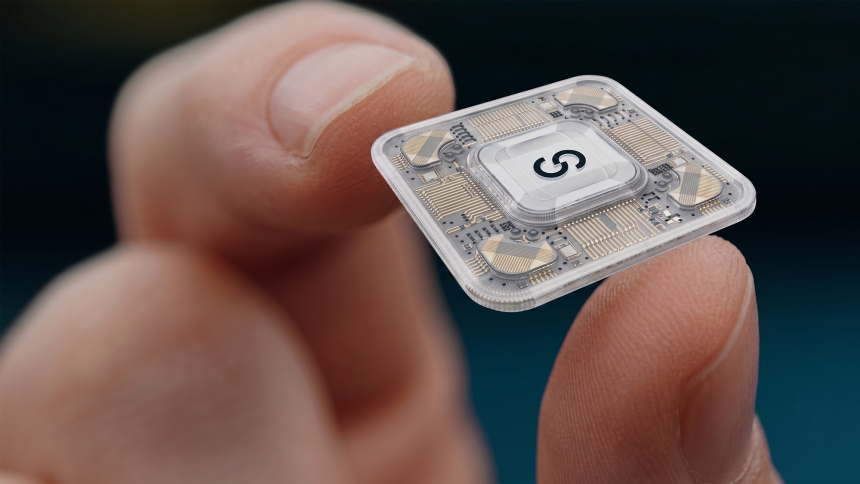
The German startup Saxon Q has brought to market quantum computers based on diamonds that operate at room temperature — without cryogenic cooling, a vacuum, or specialized laboratory conditions. On August 6, 2026, the publication Live Science described this development as “the world’s first portable room-temperature quantum computer.” Although the striking superlative “world’s first portable” is more a journalistic framing than the company’s own marketing claim, the technology itself is entirely real and marks an important step in the development of accessible quantum computing.
The company Saxon Q was created as a spinoff of Leipzig University. Among its founders are Professor Marius Grundmann, a professor of experimental physics, and Professor Jan-Berend Meijer, the chief technology officer, a specialist in ion-beam implantation; the position of chief executive officer is held by Dr. Frank Schlichting. Around July 21, 2026, the company commercially unveiled two models: the SXQ128 with 128 physical qubits and the SXQ512 with 512 qubits.
The technological basis of these machines is nitrogen-vacancy (NV) centers in synthetic diamond. These are special defects in the crystal lattice of a diamond that can act as qubits and, critically, retain their quantum properties at room temperature. It is precisely this that distinguishes Saxon Q’s approach from most modern quantum computers. Leading systems based on superconducting qubits (as in IBM or Google) or on trapped ions require cooling to temperatures close to absolute zero, giant cryostats, and complex infrastructure. NV-diamond systems, by contrast, work without cryogenics: Saxon Q’s machines, according to the company, fit into a standard server rack and are powered from an ordinary electrical outlet. It is this absence of a need for exotic cooling that makes them potentially “portable” and suitable for deployment outside specialized laboratories.
The technical characteristics the company cites also deserve attention. The stated fidelity of operations is roughly 99.92%, and for single-qubit operations, at the end of July 2026, the figure was rising to 99.98% — this is before the application of error correction. The company’s roadmap envisions scaling to more than 10,000 qubits after 2030. One of Saxon Q’s key engineering innovations is the co-implantation of sulfur atoms during the growth of the diamond, which, according to the company’s explanation, “lifts the chemical potential” and improves the control of the qubits and their yield. The SXQ128 model is available to order now with a delivery time of about three months, while deliveries of the SXQ512 are set to begin in the second quarter of 2027; the machines are built to order, and prices are not disclosed. It is also worth mentioning that a “mobile quantum computing system” from Saxon Q had already been deployed at Fraunhofer IWU as far back as June 2025.
Despite the enthusiasm, the claims should be treated with measure, and Live Science itself emphasizes this. As of now, there is no independently peer-reviewed scientific study that would confirm the full functionality of the stated number of qubits; the company’s claims rest primarily on its own technical documentation (a white paper). This is an important caveat, because in the field of quantum computing “physical qubits” and their real usefulness for solving practical problems are far from one and the same. The number of qubits by itself means little without data on the error rate, connectivity, coherence time, and the ability to execute useful algorithms. Therefore, the real capabilities of Saxon Q’s machines will only be possible to assess after independent verification.
It is also important to dispel a possible confusion. Saxon Q is not the only company working with diamond NV qubits at room temperature. Another well-known firm in this niche is Quantum Brilliance, an Australian-German company whose systems have been deployed at the Pawsey Supercomputing Centre, Oak Ridge National Laboratory (ORNL), and Fraunhofer IAF. This is a separate, likewise entirely legitimate company, but it is precisely Saxon Q that is the subject of the specific news about a “portable” quantum computer. Both firms illustrate a broader direction of research that bets on diamond qubits specifically for the sake of operation without cryogenics.
Why does this matter for the industry as a whole? Quantum computing has for decades been associated with enormous, ultra-complex, and ultra-expensive installations, accessible only to a few labs and corporations. The approach based on diamond NV centers promises a different scenario: compact quantum accelerators that can be installed alongside ordinary servers, integrated into existing IT infrastructure, and used for specialized tasks without building cryogenic systems. Even if such machines fall short of superconducting systems in “raw” power, their accessibility and simplicity of deployment could open quantum computing to a much wider circle of users — from industrial research centers to universities. How far this promise will be realized will be shown by the coming years and, most importantly, by independent verification of the real capabilities of these systems.
It is also worth soberly assessing what such systems are suitable for today and what they are not yet suitable for. Even in the most optimistic scenario, compact quantum accelerators are unlikely to replace classical supercomputers in the coming years; their realistic role is narrowly specialized tasks where quantum methods have an advantage: certain types of optimization, the modeling of molecules and materials, and individual cryptographic applications. The key barrier for all quantum platforms without exception remains error correction: to move from “physical” qubits to “logical” ones — stable and suitable for lengthy computations — thousands and tens of thousands of physical qubits are required for each logical one. That is why Saxon Q’s roadmap, with its move beyond 10,000 qubits after 2030, is not a marketing detail but a necessary condition for practical usefulness. In sum, the appearance of accessible diamond systems is an encouraging signal of the diversification of approaches to quantum computing, but the real weight of these machines will be determined not by press releases but by independently confirmed results over the coming years.
Sources: Live Science, The Quantum Insider, Quantum Computing Report, HPCwire (July–August 2026).