

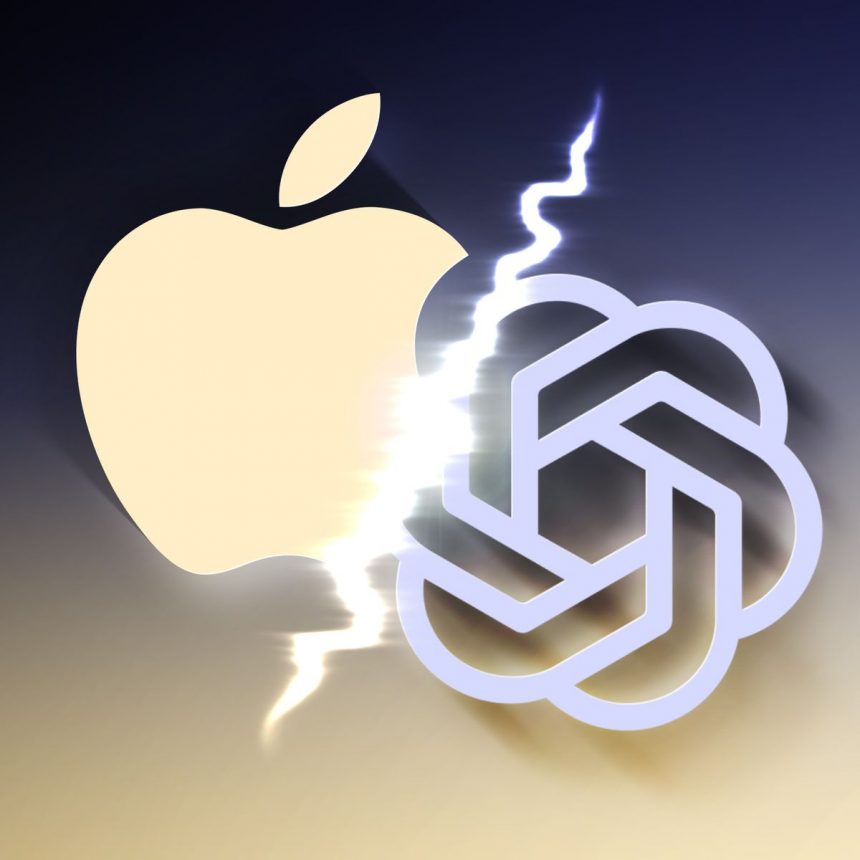
The legal standoff between two technology giants has entered a new stage: on August 6, 2026, OpenAI filed a motion to dismiss Apple’s lawsuit, in which the iPhone maker accuses the company of stealing trade secrets. OpenAI called the accusations “baseless,” “meritless,” and “pretextual,” making clear that it intends to defend itself vigorously. This case — separate from the antitrust lawsuit brought by Elon Musk’s xAI — has become one of the loudest corporate court conflicts of the year and reflects the intensifying battle for talent and technology at the intersection of the artificial-intelligence and consumer-electronics industries.
To understand the essence of the conflict, it is worth returning to the beginning. Apple filed its lawsuit on July 10, 2026, in the U.S. District Court for the Northern District of California. The defendants were OpenAI itself and two former Apple employees: Tang (“Yew”) Tan — now OpenAI’s chief hardware officer, who worked at Apple for 24 years as vice president of product design for the iPhone and Apple Watch, and Chang Liu — a senior OpenAI engineer who worked at Apple for about eight years. Apple claims that this was a deliberate scheme to extract trade secrets “at every level.”
The specific accusations are quite detailed. According to Apple’s version, Tan allegedly used Apple project code names during recruiting, advised candidates to bring Apple hardware components to interviews, and coached departing employees on how to circumvent security measures. Liu, the plaintiff claims, did not return an Apple work laptop, downloaded confidential technical documents, and shared them. Among the materials that were allegedly compromised, Apple names engineering presentations, project data, and a “proprietary metal finishing technique.” The company also emphasizes that more than 400 former Apple employees moved to OpenAI, building a narrative of a systemic drain of knowledge and personnel.
A key context of the case is OpenAI’s ambitions in hardware. Tan at one point became a co-founder of the startup io Products together with the legendary designer Jony Ive, who for decades shaped the aesthetics of Apple’s products. In July 2025, io merged into OpenAI, and it is with this that the company’s work on as-yet-unrevealed AI devices is associated. For Apple, the appearance under OpenAI’s wing of both a former key hardware designer and Ive himself likely looks like a direct threat — an attempt to create a new class of consumer devices, drawing on the experience of the people who built Apple’s products.
In its motion to dismiss, OpenAI advances several lines of defense. First, the company argues that Apple failed to clearly identify exactly which trade secrets are subject to protection — and without that, a lawsuit over their theft cannot stand. Second, OpenAI insists that it is building “something entirely new and different from anything at Apple,” meaning it neither needs nor uses a competitor’s work. Third, the company shifts responsibility onto Apple’s own policies: if personal iCloud accounts were allowed on work devices, then any intermingling of data is a consequence of Apple’s own systems and rules. OpenAI’s wording was apt: “Apple cannot transform the foreseeable consequences of its own systems and policies into evidence of theft.”
Even before filing the motion, OpenAI went on a public offensive: on August 4, 2026, the company published a blog post titled “Apple is getting this wrong,” in which it denied any intent to obtain Apple’s secrets. Such a step — bringing the dispute into the public arena — signals that both sides are prepared to fight not only in the courtroom but also for public opinion.
Ahead lies a busy procedural schedule. OpenAI’s formal response to Apple’s request for a preliminary injunction is due by August 17, 2026, and a hearing on that injunction is scheduled for October 1, 2026. It is precisely the preliminary injunction that is the sharpest short-term risk for OpenAI: if the court grants it, it could restrict the company’s activities in certain directions even before the case is heard on the merits.
It is important not to confuse this case with other legal conflicts surrounding OpenAI. Separately, there exists the antitrust lawsuit by Elon Musk’s xAI / X against Apple and OpenAI, filed back on August 25, 2025, which claims that Apple’s partnership with OpenAI is anticompetitive and harms the Grok chatbot and the X platform. This is an entirely different case with a different legal logic — antitrust rather than trade secrets. There is also a separate trade-secrets dispute between xAI and OpenAI. The current motion concerns specifically Apple’s lawsuit.
This story is a vivid example of how the collision of the worlds of “hardware” and artificial intelligence gives rise to new legal fronts. As OpenAI moves from purely software products toward physical devices, it inevitably intrudes onto Apple’s territory — and, together with the people who previously built the Cupertino products, brings with it the risk of court conflicts. How the standoff ends will depend on the court’s decisions in the autumn of 2026, but even now it demonstrates how high the stakes have become in the battle for the future of consumer AI devices.
The figure of Jony Ive and OpenAI’s ambitions in hardware give the conflict particular acuteness. Ive, who for decades shaped the aesthetics of Apple’s products — from the iMac to the iPhone — after leaving Cupertino founded a design firm and the startup io, which in July 2025 merged into OpenAI. Together with Tan, Apple’s former vice president of hardware design, OpenAI assembled a team of people who literally built the most successful consumer devices of the past two decades. The goal is to create a new class of AI devices that could become as breakthrough a category as the smartphone once was. For Apple, the prospect of the appearance of such a product, developed by its own former key specialists, looks like a direct strategic threat, and many attribute to this the persistence with which the company launched its legal offensive.
This case also lays bare a fundamental tension between the protection of intellectual property and the mobility of talent — a topic especially sensitive in California. The state is known for the fact that non-compete agreements here effectively have no legal force, and the free movement of engineers between companies is considered one of the engines of Silicon Valley’s innovation. At the same time, trade-secret laws remain a powerful tool, and it is precisely on them that Apple relies. The line between “the knowledge and experience that an employee has the right to take with them” and “the specific trade secrets of a former employer” is often blurred, and courts examine such cases extremely closely. The outcome of the Apple–OpenAI standoff could have an impact far beyond these two companies: it could outline how aggressively technology giants will be able to use trade-secret lawsuits to stem the outflow of personnel to competitors. That is why the entire industry will be watching the decisions of the California court in the autumn of 2026.
Sources: Axios, Bloomberg, MacRumors, TechCrunch, CNBC (July–August 2026).